It has been a couple of years and I thought I’d do an update to Crossfire Armour – Balagan House Rules (2nd Edition). This brings it to version Beta 0.3. The big change is in firepower but there are some other changes as well.
Crossfire Musing
I’ve collected together some interesting Crossfireideas from other people. I’ve reproduced them here mainly so I don’t have to go hunting for them again. Most rule variations are untried. Some items – Base Sizes for example – are there because people ask about them a lot, so in some ways this section is a FAQ, but not quite. See also my real FAQ.
In particular I’ve musings on: Command Control, Troop Types, Vehicles, Shooting, Terrain, Converting from other Game Systems, v2 wish list. Plus a whole bunch of other stuff.
Will Standard Crossfire Work for Vietnam?
After reviewing What to Simulate in a Vietnam War Company-Level Game, I decided to take a closer look at whether standard Crossfire could handle it. By “standard Crossfire,” I mean the version in the rulebook (plus HTD), where a rifle stand represents a squad of 9–12 men.
The short answer? It doesn’t — but I already knew that.
The point of the exercise was to identify the gaps. And those are exactly the gaps I’m aiming to fill with Wombat Gun, my draft variant for the Vietnam War.
What to Simulate in a Vietnam War Company-Level Game
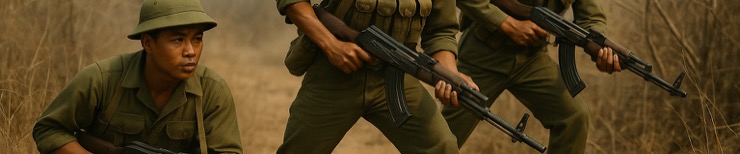
I’ve been toying with the idea of creating a variant of Crossfire for the Vietnam War—still at company level, just like standard Crossfire. I’m tentatively calling it Wombat Gun.
Then the other day, Adam came over and we played Charlie Don’t Surf by the Two Fat Lardies — another company-level game. That session really got me thinking: what are the key elements worth simulating in a Vietnam War company-level wargame?
Here’s where I’ve landed so far. These are the key features of the conflict that I think any ruleset should simulate. Please share if you have other ideas.
Kiwis vs FJ in Italy – A Crossfire Scenario
We’ve played this a couple of times now so I thought I’d put it into my scenario format. This is a Crossfire scenario for a fictional battle between 2 NZ Division (Kiwis), including Kiwi Armour, and German paratroopers (Fallschirmjäger). It is primarily to play test my Balagan House Rules for Crossfire Armour (2nd Edition).
Download the Balagan House Rules for Crossfire Armour
People often criticise the armour rules in Crossfire. For anybody who, during 2022 and 2023, was following my Musing on Revised Crossfire Anti-tank Rules, you can download the final Crossfire Armour – Balagan House Rules here. Enjoy.
Revised guidance for terrain set up in Crossfire
I got into a discussion with George Breese on Crossfire maps on the Crossfire WII forum. We were talking about the attributes of a good table. George uses a guideline that “tables should be 1/3 to 1/2 terrain”. This echoes a guideline from the Crossfire rule book the table should have at least 1/3 coverage. And that got me wondering whether my maps obey a 1/3 to 1/2 terrain coverage guideline? The answer is no, but I’m not sure it is a problem.
Steven’s growing collection of wrecks
I have a growing junk yard comprising nicely painted, but wrecked, vehicles. Nominally these are potential objectives for Crossfire, but I’ve only ever used one wreck. That was the Fieseler Fi 156 Storch for Papa Eicke. The rest of my junk yard are, well, waiting for inspiration for a Crossfire Scenario. These are all 15mm scale.
Musing on Terrain Density in Crossfire
One of the Frequently Asked Questions (FAQ) for Crossfire is Are real terrain features represented 1:1 on the table? The answer is “no”. A single real-world terrain feature can be presented by more than one Crossfire terrain feature (e.g. woods) or several real-world features can be grouped together as one on the table (e.g. buildings). In this post I explore that answer a bit more at least for woods, fields, hills and rough ground.
How big are Crossfire Terrain features
Sometimes people ask, how big should my Crossfire terrain be? It is really up to you. For myself, I started Crossfire using whatever terrain I had, but over the years I have standardised on the sizes. This is to make it easier to Draw Maps for Crossfire Scenarios. Check out the various Crossfire terrain type if you don’t recognise some of those I mention.
Ground Scale in Crossfire with Maps
In my previous post on Ground Scale in Crossfire I concluded that anything 1:300 to 1:1700 is defensible, but my own preference is 1:1000. I’ve taken that further and compared my preference with the extremes. What do 1:300, 1:1000, and 1:1700 look like on table.
Musing on being stationary in Crossfire
Crossfire and Hit The Dirt have several mechanisms for being stationary. I thought I’d list them to see if I get any insight for my revised anti-tank rules
Unlimited Vehicle Movement – Revising Crossfire Anti-tank Rules 8
My recent musing on the anti-tank rules in Crossfire got me thinking about my current rules on vehicle actions. CF11.1 Vehicular Actions is massively restrictive as it only gives vehicles the option to move or shoot. So I for 20 years I’ve been giving vehicles multiple move actions (1-3 depending on speed) and unlimited shooting. Both of these rules are contrary to the unlimited actions of infantry in standard Crossfire. It would be great to give vehicles unlimited actions, like the infantry. So I look at the rules that have come before then look at options for unlimited vehicle movement.
Japanese Roadblock – A Crossfire Experiment
With my Japanese all ready to go and my head full of roadblocks in Burma, I thought I’d knock together a Crossfire game. Chris took defending Japanese. Adam was the British trying to break through. I call this an experiment because very little thought went into it and we were just playing around with the concept of a Japanese ambush.
Almost Fosse Bridge – A Crossfire Battle Report 2
Gunnery Sargent Rock (Bruce Stewart) played my Almost Fosse Bridge Scenario. This is the Italian Campaign. All words are Bruce’s.
Musing on Japanese house rules in Crossfire
My Japanese leg infantry battalion for Crossfire is now painted and based. All very exciting! The more I read about the Japanese, the more I realise they had a completely different mind set to western armies. I wonder how much of that difference should flow through into Crossfire. So I’ve looked at other rule sets to see how they have handled the Japanese in WW2 and, from that, possible implications for Crossfire.