
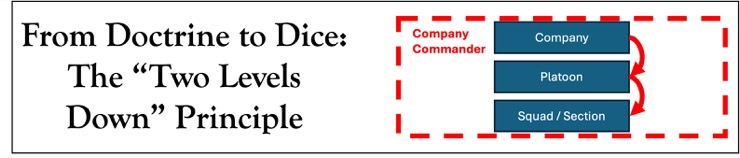
My mate Roland and I often talk about a specific principle of military command, where a commander focuses on units one or two levels down the hierarchy — no further. I wanted to use this to justify the scale of Wombat Gun, my Crossfire variant for the Vietnam War, so I went looking for its origins. In Wombat Gun, players take the role of company commanders. The “two levels down” principle is why the game tracks platoons and squads — not fire teams, not individual soldiers. Player authority is meant to mirror real-world command practice. But where did this principle come from?
Military unit hierarchy
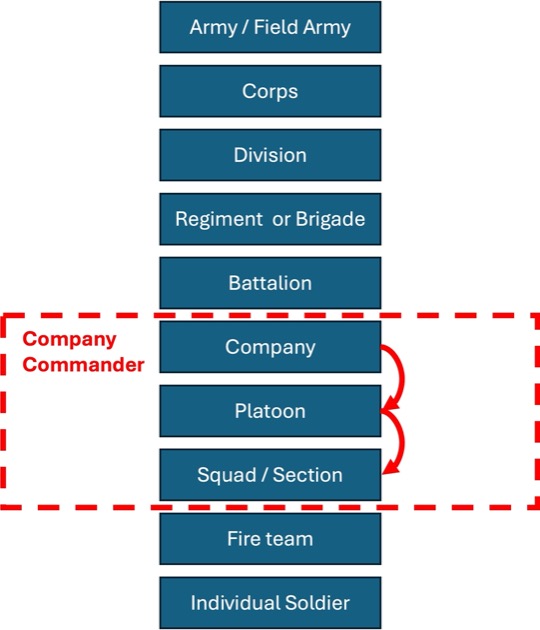
The concept starts with the military unit hierarchy. The military unit hierarchy structures forces from the individual man, through the smallest unit, the fire team, and increasingly larger formations like the squad/section, platoons, companies/troops/batteries, battalions, brigades/regiments, and divisions, culminating in large formations such as corps or armies. At each level, units are led by officers of appropriate rank, such as a sergeant leading a squad or a captain commanding a company, with command and administration functions scaling up with the unit size.
A typical hierarchy (Largest to Smallest):
| Unit | Description |
|---|---|
| Army / Field Army | The largest combined military force, formed from corps, led by a general. |
| Corps | A large formation composed of several divisions, commanded by a lieutenant general. |
| Division | A major fighting unit formed from multiple regiments or brigades, often commanded by a major general. |
| Regiment or Brigade | A larger formation made up of several battalions. In some contexts, such as the British Army, a regiment may have sub-units equivalent to companies, like squadrons for cavalry or troops for artillery. |
| Battalion | Formed from several companies and commanded by a lieutenant colonel. |
| Company | Made up of multiple platoons, led by a captain or major. The company level is often the lowest where administrative functions are introduced. |
| Platoon | Composed of several squads (e.g., three) and commanded by a lieutenant. |
| Squad / Section | Consisting of 7-14 men organised into two or three fire teams, and led by a sergeant. |
| Fire team | The smallest unit, consisting of a few soldiers (e.g., 4-7). |
| Individual Soldier | Single combatant; the basic element of all units. |
Basis of “Two Levels Down” Principle
I found three military theories/practices supporting the “Two Levels Down”:
- Mission‑type tactics (Auftragstaktik) commanders focus on communicating clear intent and desired effects—not detailed instructions—to the two levels down while empowering subordinate leaders to execute through initiative and flexibility.
- Command by Negation lets commanders two levels down act freely unless explicitly overridden—empowering lower echelons while the senior stays strategic.
- Intelligence Preparation of the Battlefield (IPB) ensures situational awareness and coherence two levels down in planning, without burdening higher command with minute details.
1. Mission Command / Mission-Type Tactics
Mission-Type Tactics (Auftragstaktik), known as mission command in NATO and other modern doctrines, is the military principle where a commander cares about how two levels down understand and act upon his intent — while not mandating direct, detailed control (for a company commander, that means focusing on platoons and squads). It focuses on empowering subordinates, articulating clear intent, and trusting them to execute, all grounded in decentralised initiative and centralised planning. This fosters speed, adaptability, and empowerment within established intent constraints.
In Mission‑type tactics, the senior commander defines the objective, the reason for the mission, and any constraints, then entrusts subordinates to plan and act autonomously to achieve it.
This approach has its roots in Truppenführung, a Prussian military theory that emphasised giving subordinate commanders the freedom to act within the broad intent of their senior leadership — a method designed to cope with uncertainty and fast – changing situations.
The broader doctrine of Mission Command includes seven principles such as mutual trust, shared understanding, commander’s intent, disciplined initiative, and risk acceptance
This practice:
- Ensures subordinate commanders not only know what needs to be done and why, but also are entrusted with how to achieve it within that intent.
- Prevents micromanagement, enabling agile responses while preserving overall unity of effort.
- Enables a subordinate, should the need arise, to operate two levels above his appointment; for example, a platoon commander is expected to be capable of operating at the level of a battalion.
2. Command by Negation
Command by Negation is a well-established doctrine in the U.S. Navy. It allows subordinate commanders to act on their own initiative unless explicitly countermanded by a higher authority. Subordinate commanders conduct operations independently, reporting their plans along the lines of “UNODIR” (unless otherwise directed). The superior doesn’t need to micromanage — only intervening when there’s cause for objection. This structure allows command to focus on high-level strategy and frees up senior officers from overseeing every detail, while lower tiers (e.g. two levels down) retain significant autonomy.
3. Intelligence Preparation of the Battlefield (IPB)
Intelligence Preparation of the Battlefield (IPB) is a planning doctrine used in U.S. Army operations. IPB instructs commanders to analyse and anticipate objectives down to two subordinate levels. Intelligence staff begin at least one level above their own command and work their way down to two levels below. This ensures alignment of ends, ways, and means across multiple echelons—supporting both coordination and decentralised execution. While not a command authority doctrine per se, it embeds visibility and understanding at those two levels down, without requiring awareness or control beyond that.
Two Levels Down for a Company Commander
Using the “two levels down” principle, a Company Commander would be concerned about platoons and squads/sections, but not fireteams or the individual men.
Summary using a Company Commander example
1. Mission Command / Mission-Type Tactics (Auftragstaktik): The Company Commander makes sure intent and desired effects are understood two levels down — all the way to Squad Commanders — without directing every move. Company Commander briefs Platoon Commanders on mission and “why”; Platoon Commanders transmit that understanding to Squad Commanders, who act with initiative as situations change. This ensures agility at the lowest practical level while keeping unity of effort.
2. Command by Negation: Subordinates (down to Squads) may act autonomously unless the Company Commander explicitly overrides (UNODIR: “unless otherwise directed”).A Squad Commander seizes an opportunity and engages without prior approval; the Company Commander intervenes only if it conflicts with the broader plan. Preserves subordinate freedom while keeping the commander focused on the bigger tactical picture.
3. Intelligence Preparation of the Battlefield (IPB): Planning and situational awareness deliberately extend two levels down (to Squads) to anticipate needs and align resources. Company-level IPB maps terrain, enemy, and likely actions at squad resolution so Squad Commanders can act in harmony with company intent. Coherence between company, platoon, and squad actions without micromanagement.
Using these practices, the Company Commander stays informed about, shapes, and influences actions at the Squad level (two levels down) but avoids managing individual soldiers or fire teams directly. This preserves initiative, reduces micromanagement, and keeps attention at the right tactical level.
Two Levels Down in Wargame Design
Why use it? Adhering to “two levels down” aligns player authority with real-world command practice: a player acting as Company Commander focuses on platoons and squads/sections, not fire teams or individual soldiers. This sharpens decisions, speeds play, and preserves historical feel.
Design Litmus Test
If a proposed rule requires tracking below squad level, abstract it into a squad modifier/state or lift it to platoon/company decision. Keep the player’s eyes two levels down—and the game will play like a commander’s fight.
Advantages for Designers
- Focused scale & scope: Rules target the company fight; no bloat from modelling fire teams or individual men.
- Clear decision space: Player choices live at platoon/squad level (tasking, timings, axes), not micro-placements.
- Cleaner abstractions: Morale, command & control, and logistics written for squads and platoons; bookkeeping stays bounded.
- Historical credibility: Mirrors commanders shaping two echelons down, boosting authenticity of outcomes.
- Rule economy: Fewer exception cases — movement, fire, and rally all reference the same unit granularity (squads).
- Integrated mechanics: Morale tracked at squad level with platoon cohesion modifiers; spotting resolved at squad granularity; fire & movement handled without per-fire-team states.
- Streamlined support: Support weapons attach to platoons or company HQ; casualties tracked at squad state with consolidation during rally.
- Scenario alignment: Objectives framed at company level; victory points awarded for squad-level effects; time pressure built in via short turn clocks and limited enablers.
Advantages for Players
- Reduced cognitive load: Track squads and platoons, not every fire team, not every man; more thinking, less bookkeeping.
- Faster turns: Fewer activations and dice rolls keeps tempo high and friction palpable.
- Stronger narrative: Plans, intent, and timing matter; platoons coordinate, squads execute.
- Role immersion: Players think like a company commander, balancing intent vs. opportunity without micromanage.
- Clear victory focus: Success measured through squad-level performance and company objectives, not granular kill counts.
References
Canadian Army. (2021, 15 October 15). Intelligence Preparation of the Battlefield (IPB) – Glossary of terms
de Angelis, K. and Garfield, J. (2016, October). Give Commanders the Authority. Proceedings: US Naval Institute, 142/10/1, 364. U.S. Navy.
Herrera, R. A. (2022, July-August). History, Mission Command, and the Auftragstaktik Infatuation. Military Review: Professional Journal of the U.S. Army, 1922-2025.
US Army. (1994, 8 July). Intelligence Preparation of the Battlefield. Field Manual 34-130. Author.
US Army. (2019, March). ATP 2-01.3 Intelligence Preparation of the Battlefield. Army Techniques Publication No. 2-01.3. Author.
US Joint Chiefs of Staff (CJCS). (2018, 8 June). JP 3-32 Joint Maritime Operations, Incorporating Change 1. Joint Publication 3-32.
Wikipedia: Command by negation
Wikipedia: Mission command
Wikipedia: Mission-type tactics
There have been some studies about how many elements a player can easily control in a game without slowing play. The range is about 10-15. The number of elements also applies to real world command. This corresponds to the two levels down principle. A company commander would have three to four platoons each of three to four squads for a total of nine to 16 elements. The number of elements also applies to real world command. There is also the “rule of three” where a commander ideally would have no more than three direct subordinates.
There are two concepts as part of this write up. The first is the justification for the smallest unit on the table in a war game would be 2 levels down from the command structure, in crossfire its company level with squads on the table. But wargames also need a level of abstraction that doesn’t exist in the military hierarchy. A company commander may want to communicate his intent to the squad level, they are not directly controlling those squads. In crossfire you are. You need that in a game because if you only controlled platoons with squads just acting as level of strength of the platoon, it could get kind of boring. You would only have 3-4 units under your control. You would need a different layer of abstraction to make playing with so few units interesting. Good post
Orders
One level down.
Knowledge of details of next level. That is two level down.
Another reason: human limit on number of subordinates that can be dealt with directly / more or less known.
From memory, (it was many years ago, and where did all those years go?), in Vietnam the Australian army company commanders didn’t have much influence below platoon commanders who were generally responsible for the deployment of their sections. The company commander may have outlined how he wanted the platoon commander to deploy his sections in a specific situation but that was about it. Seems like it all happened in another lifetime. Getting old sucks!
Wonderful post, thanks for collating these disparate ideas!
I’m in the fire service and could talk a lot about how we manage our fireground tactics. One thing they train all of us down to the firefighter on is the “span of control” – you can only manage up to 5 subordinate groups, preferably 3.
Thing is, in real life, once you get to the fireground, it is not at all uncommon for the chief running the fire to grab a firefighter and order him to do a task even though he has a lieutenant.
There is opportunity there for a lot of friction in a historical battle setting; when the commander exercises his right to order around subordinate units he is also breaking away from the accepted chain of communication and causing confusion (sometimes).
Excellent post, and looking forward to seeing what you do with this.
The tricky part is creating the semi-autonomous actions of the lower levels. Having theoretically transmitted the mission and plans to the lower level leaders, we need to ideally have them attempt (imperfectly) to carry out the mission, without the leader fussing over moves and fire tactics. Multi-player works, but the commander is then rather watching others play. Restrictions like those in Spearhead help – limiting movement and providing strict fire priorities. Reaction tables like Nuts! also work to a degree.
Wish there was a like button. This is a good description and explanation of the situation.