
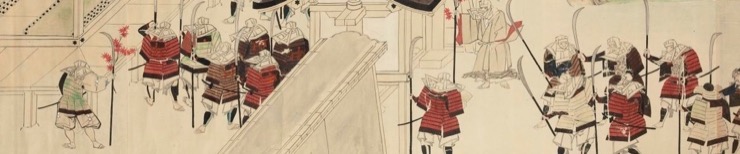
I’m working on a variant of Tilly’s Very Bad Day called Yoshimoto’s Very Bad Day for Sengoku Jidai (the Warring States period, 1467–1615) of Japan. The Daimyō Army List covers the majority of armies in this period. But there are a couple of variations I want to cover as well. The first of these are the Sōhei, the warrior monks. This list covers both Sōhei Contingents in other armies and the Hongan-ji Armies.
Gunpowder Warfare
Black powder guns from arquebus to flintlock musket. I have chosen to start this period with the discovery of the New World (1492) and end it with the Siege of Sevastopol (1854–1855).
Sub-categories: New World, Italian Wars, Eighty Years’ War, Thirty Wars’ War, War of Spanish Succession, Napoleonic Wars, Liberators, Liberal Wars, Carlist Wars, New Zealand Wars.
Yoshimoto’s Very Bad Day – Daimyō Army List

I’m working on a variant of Tilly’s Very Bad Day called Yoshimoto’s Very Bad Day. I don’t have any figures so an obvious question is, what do I have to buy? And that leads us straight to … what is the army list? This post outlines the generic Japanese army list for the draft rules.
The word daimyō means “great name”, and originally denoted a large landowner. During the Sengoku Jidai (the Warring States period, 1467–1615) it came to mean something sharper: an independent regional warlord. Earlier provincial governors had held their authority as servants of the central shogun; the Sengoku daimyō held his by force. He raised armies, levied taxes, and fought near-constant wars to defend and enlarge his domain — and his legitimacy rested on nothing more distant than that. It came from the sword: from his power to conquer, hold his borders, and keep order within his own provinces.
Musing on “Command from the Enclosure” in Yoshimoto’s Very Bad Day

A Sengoku commander-in-chief had two places he could stand. He could ride with his men, going where the fighting was hottest and lending his presence to the unit that needed it; or he could sit still, behind the line, inside a screen of curtains, and run the whole battle from one spot. The second was the honjin — command from the enclosure — and far more often than not it was where the sō-taishō chose to be. This post is about why, and about what it takes to put him on the table.
Musing on Armies, Commands, and Units in Yoshimoto’s Very Bad Day
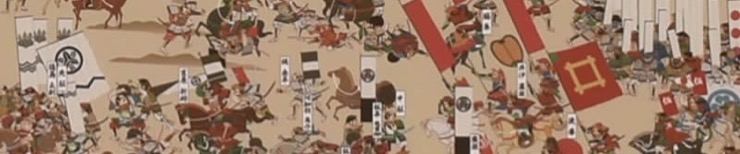
Extending my Musing on Yoshimoto’s Very Bad Day, I thought I’d lay out my thinking on armies, commands and unit. But first a reminder of what Tilly’s Very Bad Day’ does.
Musing on Yoshimoto’s Very Bad Day
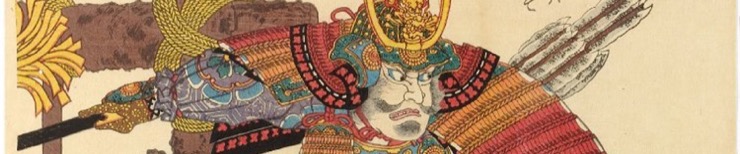
I’m thinking about writing a variant of Tilly’s Very Bad Day for the Japanese “Age of Warring States” (Sengoku Jidai). Samurai, mounted Samurai with bow or lance, Ashigaru, firearms, that kind of thing.
What follows is a set of design notes examining how Tilly’s Very Bad Day (TVBD) maps onto large battles of Sengoku-period Japan.
To be honest I don’t think Tilly’s Very Bad Day needs extensive mechanical change and the rule align closely with Sengoku warfare — provided they are framed and applied with the right assumptions.
Vargas Swamp – A Bolivar’s Very Bad Day Scenario
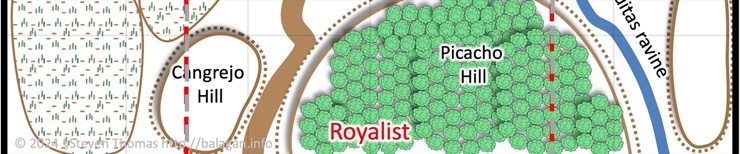
Following my write up of the the historical Battle of Vargas Swamp (25 July 1819) and my Kind of Vargas Swamp – A Bolivar’s Very Bad Day Battle Report, I thought I’d write the actual scenario.
Kind of Vargas Swamp – A Bolivar’s Very Bad Day Battle Report
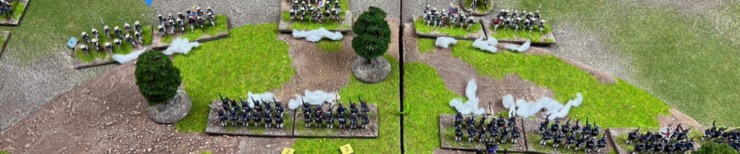
Jamie came over to play test Bolivar’s Very Bad Day, my Liberators variant of Tilly’s Very Bad Day.
I made up the scenario on the spot but it was loosely based on Battle of Vargas Swamp (25 July 1819). We had small armies on a small table. But we did have the big hill (Cerro del Picacho i.e. Picacho Hill) that featured in the historical battle.
Summary: Really good fun game. The big infantry firefight on the hill was slow and grindy, so Jamie used his overwhelming Patriot horse to turn my flank. Despite the drama of of cavalry squadrons charging up a wooded hill into the exposed flank of a Royalist battalion, the battle was secured in the centre. Jamie’s infantry managed to rout a battalion in the centre and in the process killed my C-in-C who was valiantly trying to rally the unit. Clear Patriot victory.
Download Bolivar’s Very Bad Day
I’ve been working on Bolivar’s Very Bad Day, my variant of Tilly’s Very Bad Day for the South American Wars of Liberation, for a while now. Years even. So I thought I’d make it available for download (thanks to Hugh for the nudge). It is only four pages long with another two for the Quick Reference Sheet (QRS). And there is a massive caveat: it is only Beta. I thought it better to get it out there and gather feedback. All feedback welcome.
1645 Game 12 – South-East – English Civil War Campaign

Chris and I played the 12th game of Populous, Rich and Rebellious, our four player Campaign using Tilly’s Very Bad Day, and set in the English Civil War. Actually there were four of us on the night. Adam joined me, of course, on the Royalist side. And in the absence of Jamie, Big Dave turned up from the USA to help Chris with the Parliamentarians.
Summary: Fantastic game. Parliament did some clever moves with well timed interpenetrations. Chris’s careful manoeuvring and Dave’s shear impetuousness was a winning combination. That and the fact Parliamentary shooting killed two Royalist Generals. Parliament victory.
Version 2 of Populous, Rich and Rebellious

I’ve updated Populous, Rich and Rebellious to version 2. Populous, Rich and Rebellious is a Campaign game system for the First English Civil War (1642-46) in England and Wales. The campaign assumes Tilly’s Very Bad Day as the tactical rules.
Steven’s 1819 Patriot Army on Big Bases
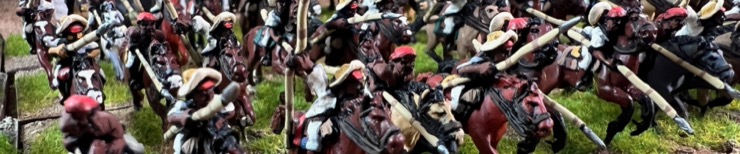
I’ve been quietly painting 1819 Patriots since I posted on my 1815-1819 War in the North – Steven’s Wargaming Project back in May 2024. Roughly a year later, it is time to unveil my 1815-19 Patriots (Phase 1 of the project). These are of course on Big Bases for South American Wars of Liberation using Bolivar’s Very Bad Day (a variant of Tilly’s Very Bad Day). The men are either from New Granada or Venezuela and I chose the units because they fought at Battle of Vargas Swamp (25 July 1819).
Draft Campaign Cards for the Vulture’s Feast

So I’ve been Musing on the Vulture’s Feast, a Thirty Years War version of my Populous, Rich and Rebellious Campaign for Tilly’s Very Bad Day. Most of the flavour of the campaign comes from the Campaign Cards. I’m not sure which ones I’ll end up with but I thought I’d share the possibilities. Please comment if you have endorsements, tweaks and/or new suggestions.
Musing on the Vulture’s Feast – A 30YW version of Populous, Rich and Rebellious
We’re really joying Populous, Rich and Rebellious, our four player Campaign using Tilly’s Very Bad Day, and set in the English Civil War. But people keep asking me, what about the Thirty Years War? (Most recently Peter Godden.)
1645 Game 11 – Wales – English Civil War Campaign

Adam and Chris played the 11th game of Populous, Rich and Rebellious, our four player Campaign using Tilly’s Very Bad Day, and set in the English Civil War.
Summary: In probably the best game yet, Parliament thoroughly crushed the Royalist defenders in Wales.
1644 Game 10 – South-East – English Civil War Campaign
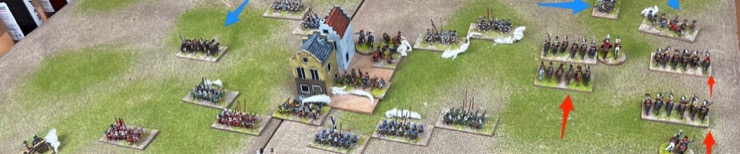
After a 10 month gap, Adam and Chris played the tenth game of Populous, Rich and Rebellious, our four player Campaign using Tilly’s Very Bad Day, and set in the English Civil War. Unfortunately we’d forgotten about Game 9 so it was a bit of a replay … with a different result.
Summary: A strong Royalist attack crushed the Parliamentary defence of the South-East.